• (This is the opening chapter of the saga — no prior beats.)
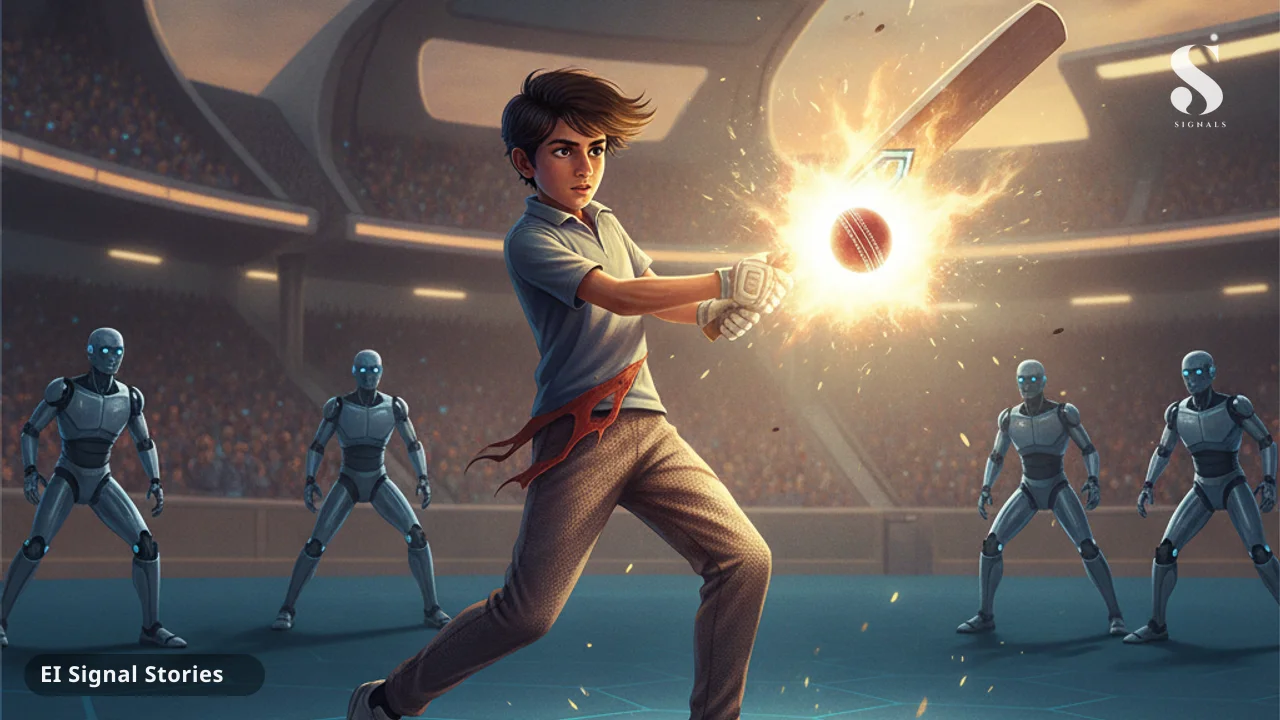
Year 2100. Chepauk Stadium. Floodlights replaced long ago by orbital mirror-arrays — thin silver discs in low orbit, angled to pour cold white daylight onto the pitch at any hour. Above the boundary, tinyRobo drones drift in lazy circles, their cyan holo-screens painting the crowd's faces the colour of swimming pool water.
But the pitch is still 22 yards. The stumps are still three. And Barath, captain of Classic Schoolboys, is still chewing the inside of his cheek the way his amma told him not to.
This is not just a match.
The year before, Classic Schoolboys had been dissolved — budget cuts, the Academy Board said. Too small. Too old-fashioned. The kind of team that still practised on a mud pitch and read paper books. Every player was scattered to corporate academies with sponsors and meal plans and robotic fielding coaches.
Then one rule saved them: the 2099 Restoration Clause. Any dissolved school team could reclaim its licence if it won the Chennai Centenary Cup — a one-off tournament, one chance, no second edition. Win, and the school reopens. Lose, and Classic Schoolboys is a name on an archived holo-page.
Last over. Six runs needed. One ball left.
The bowler walks back. His name is Brozev35. Half-robot, all silence. Eleven matches this tournament. Eleven wickets the moment he chose to take them. The commentators have stopped calling it bowling. They call it *the trick*.
Because Brozev35's ball does something no ball should do.
It changes shape mid-air.
Here is how the 2100 rulebook allows it.
After years of batsmen dominating with neuro-sync gloves and predictive-swing sensors, the ICC brought in the Chaos Ball Amendment of 2087: once per innings, a bowler may deliver a Morph-Certified ball — a regulation leather ball coated with a licensed reactive compound — that undergoes a visible surface transformation mid-flight. One delivery. One trick. Like the bouncer rule of 2020, but stranger.
Brozev35 saves his for the last ball.
Always the last ball.
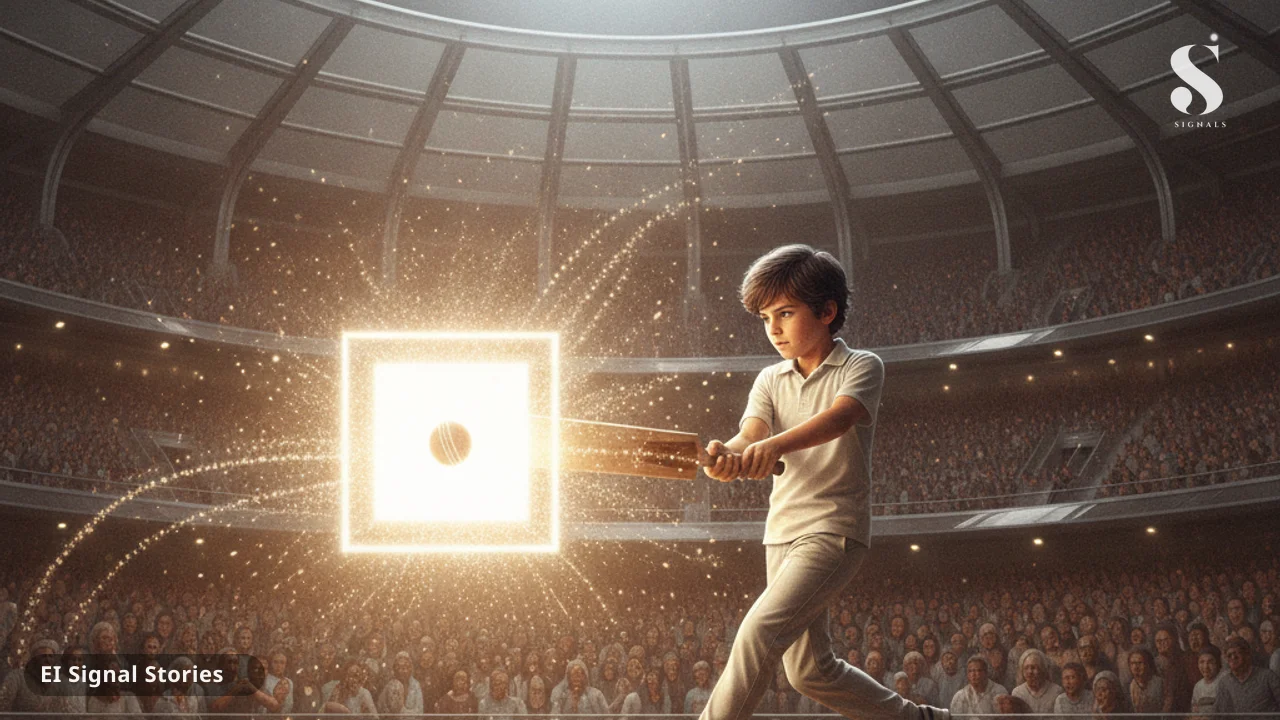
Barath has watched the footage forty times in the dugout. Frame by frame. The ball leaves Brozev's hand — round, red, ordinary. Halfway down the pitch — *FLASH*. A white flame, no bigger than a sparkler's crown. And then the ball appears to be a SQUARE. Edges, corners, the works. The batsman's eyes chase the corners. The bat swings at where the corners *should* go. The stumps fall.
Eleven times.
In the dugout, Coach Lax — Lakshmi, but nobody calls her that — had crouched next to him and said only one sentence.
"Watch the weight. Not the shape."
Barath had nodded the way boys nod when they don't understand but don't want to look small.
Now, with one ball to go, he turns to Sozhi — the team's mini-robo, perched on the boundary rope like a polite crow. In 2100, every school team is allowed one AI assistant the size of a lunchbox. Sozhi is theirs: dented, third-hand, runs on a twelve-year-old processor. The corporate teams have Sozhi-Ultras. Classic Schoolboys have this.
"Sozhi. What is happening to the ball mid-air?"
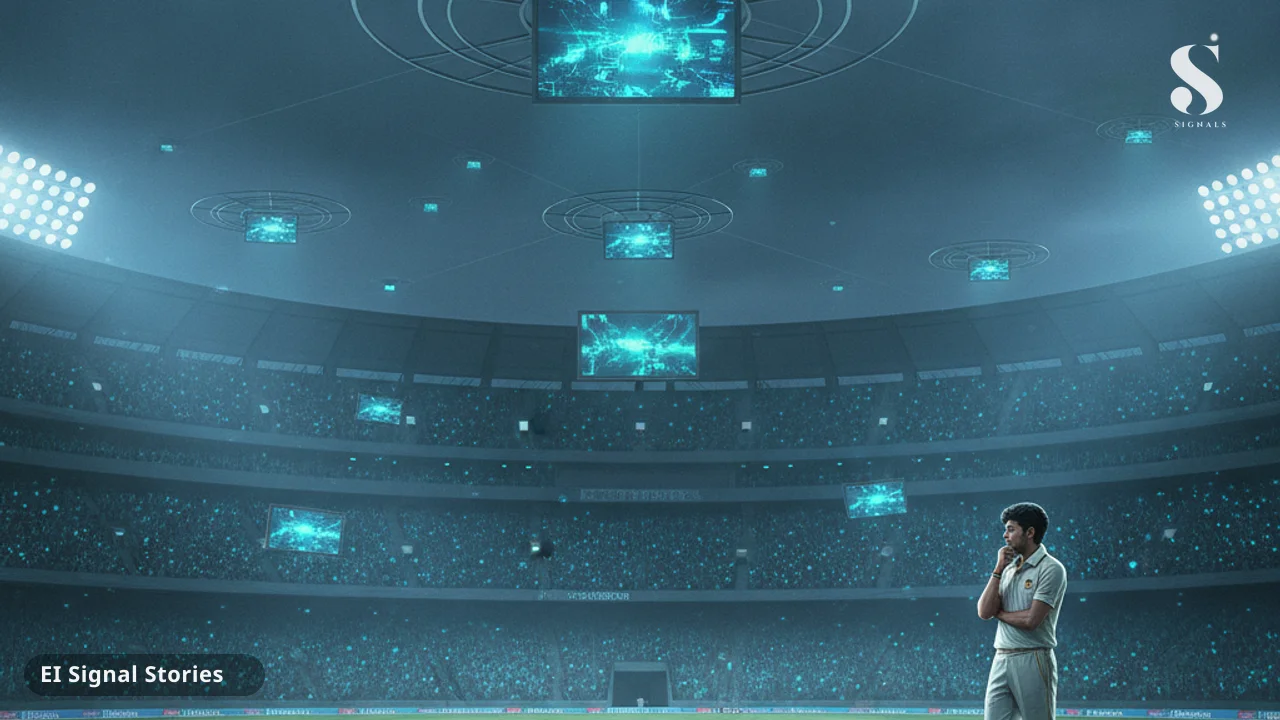
Sozhi's lights blink. "A spherical object is undergoing apparent geometric transformation."
Barath grits his teeth. He tries again.
"Sozhi — the ball is coated with something. What compound reacts with air to make a blinding white flame and very little smoke?"
The lights blink faster. "Magnesium. Reaction: 2Mg plus O₂ produces 2MgO. Brilliant white flame. Very low smoke. Reaction completes in under 0.3 seconds."
Barath's stomach drops the way it does before exams.
Magnesium. The ball is wrapped in a hair-thin lattice of magnesium thread sewn under the leather. Legal under the Amendment — the compound is licensed, the flash is certified. Brozev triggers ignition with a nano-spark from his palm at the moment of release. The thread burns — bright, blinding, a square-shaped flare fixture around the ball. The eye sees a square. The brain swings at a square.
But underneath the flame —
Barath whispers it before he means to. "The ball is still round."
Coach Lax, behind him, is rolling a black river stone in her palm — the same one she has carried since her own playing days. She doesn't turn around. "Say it again, kanna."
"The atoms only rearranged." He is thinking aloud now, the way he does in class when something locks into place. "Magnesium reacted with oxygen. But that means — wait. Let me count."
He holds up his fingers. Sozhi's little screen flickers the equation in orange light:
2Mg + O₂ → 2MgO
"Two magnesium atoms go in on the left side," Barath says slowly. "One oxygen molecule — that's two oxygen atoms bonded together — goes in on the left side. Total: two Mg, two O entering the reaction."
He moves to the right side of the invisible arrow in his mind.
"Out comes 2MgO. Two units of magnesium oxide. Each unit has one Mg and one O. So: two Mg, two O leaving the reaction."
He looks at Sozhi. "Both sides match. Two Mg on the left, two Mg on the right. Two O on the left, two O on the right. Nothing appeared. Nothing disappeared."
Sozhi beeps once. Confirmation.
"The atoms just changed partners," Barath says. "Magnesium grabbed oxygen. Became magnesium oxide. Different costume. Same mass."
Coach Lax finally smiles. "The ball lost nothing. Not one atom. Not one milligram."
"The weight didn't change," Barath says. His eyes go to the pitch. "The magnesium became magnesium oxide — ash, maybe, drifting off like dust — but the leather ball underneath burned nothing. It weighs what it weighed when Brozev picked it up."
He looks up at her. "A 156-gram ball is still 156 grams after the flash."
Coach Lax holds the black stone up in the orbital light. "I have carried this since I was your age. Same weight it was the day I found it by the Adyar river. Same atoms. Same mass. The river water wore it smooth — that was a physical change, not chemical — but even in a chemical reaction, the universe is a strict accountant. Every atom clocks in on the left side of the equation and clocks out on the right. Not one goes missing."
Barath walks to the crease. His hands stop shaking somewhere between the boundary and the pitch.
Up in the stands, the orbital mirrors have shifted three degrees — it is past midnight — and the crowd's faces shift from white to a colder silver. Eighty thousand people. The last Chennai Centenary Cup final that will ever be played. Tomorrow, if Classic Schoolboys lose, the school's name enters the archive. Forty years of mud-pitch cricket. Gone.
Barath taps his bat twice on the crease. Old habit. His grandfather taught him.

His grandfather had played on this same pitch, in 2041, before the orbital mirrors, under actual floodlights.
Brozev35 runs in. The arm comes over. The ball leaves — round, red, ordinary.
*FLASH.*
The square arrives. Edges screaming with white light. Every neuron in Barath's body wants to chase the corner on the off-side.
He doesn't.
He watches the weight. Not the shape.
He swings where a 156-gram leather ball must be — because mass cannot lie, even when shape does. His bat meets something round inside something square.
The sound is older than cricket. *Tock.*
The ball — round again now, the magnesium fully spent, just fine MgO particles scattering in the orbital light like ash off a temple lamp — sails over long-on. Over the sightscreen. Over a tinyRobo drone that has to dodge sideways.
SIX.
The stadium does not cheer for one full second.
One second of eighty thousand people holding the same breath.
Then everything breaks open. The orbital mirrors catch the noise and scatter it upward, into the night sky, as if the city itself is exhaling.
Brozev35 stands at the top of his run-up, head tilted 4.7 degrees, processing. His algorithms did not include a boy who learned to count atoms. He runs the scenario again. And again. The answer does not change. He was beaten by a balanced equation.
Coach Lax doesn't run onto the field. She keeps rolling the black stone in her palm. Same weight as yesterday. Same weight as the day she lost her own final, twenty years ago. Same atoms. Different arrangement.
Barath looks at her across the boundary. She mouths four words.
"The shape lied, kanna."
He finishes it for her, grinning through stadium noise loud enough to shake the drone swarms out of formation.
"The weight didn't."
Far above, one of the orbital mirrors catches the last of the MgO ash still floating in the floodlit air over Chepauk — two magnesium atoms, two oxygen atoms, now locked together in a new compound, drifting slowly toward the boundary rope.
The atoms did not come from nowhere. They will not go nowhere.
They were counted on the way in.
They were counted on the way out.
The universe checked both sides of the equation and said: *correct*.
Three hours later, in the Classic Schoolboys' cramped victory room — a converted storage cupboard with a borrowed holo-projector — Sozhi displays the equation one more time on the wall while the team eats cold biryani from steel boxes.
2Mg + O₂ → 2MgO
Left side: 2 magnesium atoms. 2 oxygen atoms. Total mass = X. Right side: 2 magnesium oxide units. Each holds 1 Mg + 1 O. Total atoms: 2 Mg, 2 O. Total mass = X.
Same. Exactly same.
Priya, the team's opener, stares at it between mouthfuls. "So the flash was real. The burning was real. But the trick was fake."
"The trick was real," Barath says. "The *square* was fake. A flash that bright, that fast — your eye fills in corners that aren't there. But the ball had to travel where a round 156-gram object travels. Physics doesn't negotiate."
"Because atoms don't vanish," says Sozhi, helpfully, from the corner.
"Because atoms don't vanish," Barath agrees.
Outside, somewhere in the 2100 Chennai night, the orbital mirrors begin their slow drift back to day position. The city below — towers wrapped in vertical gardens, delivery drones queued in invisible air-lanes, streets lit by bioluminescent pavement — hums and glitters and breathes.
And in a lab on the seventh floor of the nearest sky-tower, a researcher is watching magnesium ribbon burn in a sealed chamber, measuring the mass of the ash against the mass of the ribbon and the oxygen consumed, and confirming — as scientists have confirmed since long before orbital mirrors or Chaos Ball Amendments — that both sides of the scale read the same.
They always do.
They always will.
Key Takeaway — The Atom Count:
A chemical reaction reshuffles atoms. It cannot create or destroy them. When magnesium burns:
2Mg + O₂ → 2MgO
*Left side:* 2 Mg atoms + 2 O atoms (the O₂ molecule carries two oxygens bonded together). *Right side:* 2 MgO units = 2 Mg atoms + 2 O atoms.
Count left. Count right. They match. That is a balanced equation — the universe's receipt proving nothing was stolen during the reaction. Brozev35's trick worked on eleven batsmen because they trusted their eyes. Barath beat it because he trusted the count.
*Same atoms. New clothes. Same mass. Always.*
Before You Go — A Question for You:
Life will throw a lot of dazzling squares at you — flashy distractions, loud opinions, things that look impossible. The trick is to stop chasing the shape and start counting the truth underneath. The atoms never lie. The weight never lies. Only the flash does.
So here's the real question, kanna:
*The next time something tries to fool your eyes — will you swing at the shape it shows you, or at the weight you know is there?*